
How objective physiotherapy assessment and biofeedback can support women and men through the fertility journey
When the fertility journey starts to feel like a journey away from your body
Infertility can make the body feel like a source of questions. There may be appointments, investigations, treatment cycles, waiting periods and repeated conversations about results. For some people, the longer the journey continues, the more attention becomes fixed on numbers and outcomes - while everyday sensations such as tension, discomfort, posture, movement, breathing and muscle control can fade into the background.
That experience is not limited to women. Fertility is a shared journey, and both partners may experience stress, uncertainty and changes in how they relate to their bodies. Medical fertility assessment remains essential, but a broader, person-centred approach can also ask a different question: how is the body functioning, and what can we understand from that?
This is where physiotherapy can have a meaningful supporting role. Rather than presenting physiotherapy as a treatment for infertility itself, the focus is on identifying and addressing relevant physical and functional concerns - such as pelvic muscle dysfunction, pain, movement limitations or difficulty coordinating contraction and relaxation - when clinically appropriate.
The goal is not to replace fertility medicine. It is to add another layer of understanding: from "What does the report say?" to "What is my body doing?"
Fertility is a shared journey, and body awareness is shared too
Infertility is often discussed as if it belongs primarily to one partner. In reality, fertility care involves both individuals, and the emotional and physical effects can be experienced by both. Men may face pressure around semen results, sexual performance or expectations. Women may experience repeated procedures, pelvic discomfort, hormonal changes or the cumulative stress of treatment. Either partner can also become more aware of pain, tension, fatigue or changes in physical confidence.
A body-aware approach does not assume that every physical symptom is a cause of infertility. Instead, it recognises that the body deserves attention throughout the fertility journey. When clinically relevant, physiotherapy can assess movement and muscle function, explain what is being observed, and give the person practical ways to participate in rehabilitation.
From guessing to measurable understanding
Pelvic floor and other movement-related problems can be difficult to understand from symptoms alone. A person may know that something feels uncomfortable or that a movement does not feel right, but it can be difficult to describe how consistently a muscle activates, how well it relaxes, or whether coordination changes during a task.
Clinical examinations and patient-reported experience remain important. Objective assessment can add another layer by giving the clinician measurable information about muscle activation, coordination, endurance and movement quality. This can make the rehabilitation conversation more concrete: what was observed, what needs attention, and what changes over time.
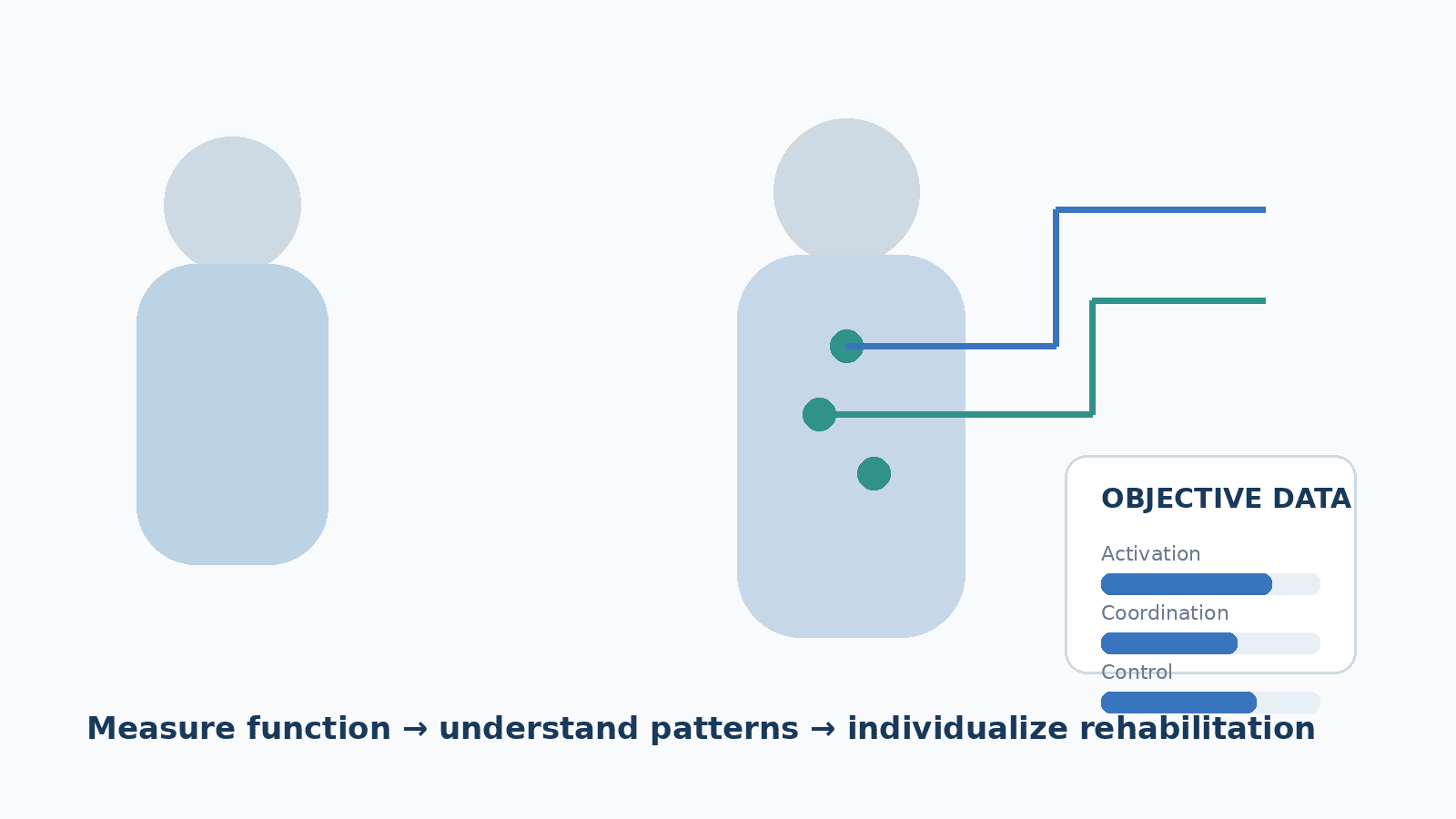
Conceptual illustration: objective assessment can turn an otherwise invisible aspect of muscle function into measurable information.
Where Pheezee can help: first, objective assessment
Pheezee can support physiotherapists by adding objective information to clinical assessment. Instead of relying only on what a patient feels or what a clinician can observe, the system can capture real-time information related to muscle activity and movement during selected assessments and exercises.
For a patient experiencing pelvic or musculoskeletal concerns during the fertility journey, this can help the physiotherapist explore questions such as: Is the muscle activating as intended? Can the person coordinate the movement? Is the muscle able to relax after activation? How does performance change across repetitions or sessions?
The value is not simply the number on a screen. The value is the clinical interpretation of that information. A physiotherapist can use objective findings alongside symptoms, examination and medical history to decide whether a person needs education, movement retraining, pelvic rehabilitation, strengthening, relaxation-focused work or another appropriate intervention.
What objective assessment can add
- A baseline: documenting muscle performance before rehabilitation begins.
- Clarity: helping the clinician identify functional patterns that may be difficult to observe directly.
- Individualisation: using assessment findings to select and progress exercises according to the person's needs.
- Communication: giving the patient a visual and measurable way to understand what the clinician is assessing.
- Progress tracking: comparing measurable performance across rehabilitation sessions.
Then comes the shift from assessment to awareness: biofeedback
Assessment tells us what is happening. Biofeedback can help the person learn from that information while exercising.
When a patient cannot easily feel whether a muscle is contracting correctly, contracting too strongly, or relaxing fully, real-time feedback can make an otherwise invisible process easier to understand. With appropriate clinical guidance, the patient can attempt a movement, see the corresponding feedback, adjust the contraction or relaxation, and try again.
This creates a useful loop: perform ? see ? understand ? adjust ? repeat. Over time, that process can support body awareness and active participation in rehabilitation. It can also make exercise instruction less abstract, because the patient is not simply being told to "activate the muscle" - they can work with the clinician to understand what appropriate activation looks like for them.
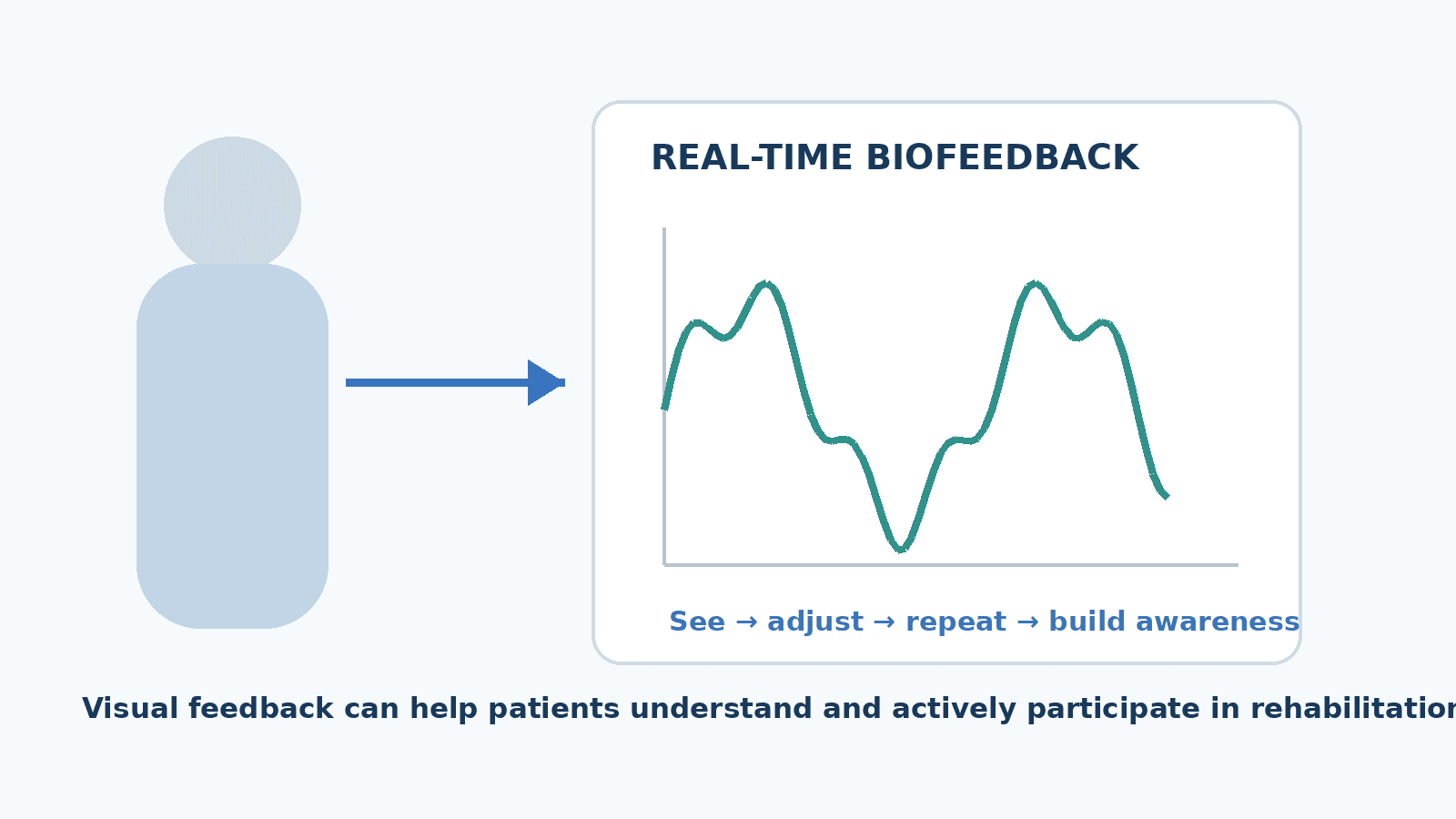
From infertility stress to body awareness
Stress can change the way people experience their bodies. During a prolonged fertility journey, attention may become centred on reproductive outcomes, while muscle tension, breathing patterns, posture, pain and movement habits receive less attention. This does not mean that stress is the cause of infertility, nor does it mean that physiotherapy can resolve infertility. It means that the person's physical experience still deserves care.
A physiotherapy-led approach can create a different kind of conversation: What do you notice in your body? Where do you hold tension? Which movements are comfortable? Can you contract and relax the relevant muscles with control? What changes when you receive feedback? These questions can help move the patient from uncertainty toward greater understanding of their own physical function.
For some patients, that shift itself can be valuable. Progress does not have to be defined only by a fertility test or pregnancy outcome. Within rehabilitation, progress may also mean improved movement, better muscle control, reduced discomfort, greater confidence with exercise, or a clearer understanding of the body.
Why this matters for both women and men
| The person may experience | What physiotherapy can explore | How Pheezee may support the process |
|---|---|---|
| Pelvic discomfort, tension or movement concerns | Muscle function, coordination, movement and relevant physical symptoms | Objective information during selected assessments and exercises |
| Difficulty understanding how to activate or relax a muscle | Motor control and exercise technique | Real-time feedback to support learning |
| Uncertainty about rehabilitation progress | Change in measurable muscle performance over time | Session-to-session objective tracking |
| Stress, reduced confidence or feeling disconnected from the body | Body awareness, education and active participation | Visual feedback that makes an otherwise invisible process easier to understand |
An important distinction: Pheezee is a rehabilitation support, not an infertility diagnostic
Pheezee should not be presented as a tool that diagnoses infertility, identifies the cause of infertility, or predicts pregnancy. Fertility diagnosis and treatment remain within appropriate medical care and may involve reproductive medicine, gynaecology, urology/andrology and other specialists.
Its role in this context is narrower and clinically useful: to support physiotherapists in objectively assessing relevant muscle and movement function, guiding rehabilitation, providing real-time biofeedback during appropriate exercises, and monitoring functional change.
A more complete fertility-care journey
- Medical evaluation - Investigate fertility concerns through appropriate medical assessment.
- Listen to the body - Recognise pain, tension, movement limitations and other relevant physical experiences.
- Assess objectively - Where physiotherapy is indicated, establish measurable information about relevant muscle and movement function.
- Rehabilitate - Use individually selected exercises, education and movement strategies.
- Use biofeedback - Provide real-time feedback when it can help the patient learn and refine muscle control.
- Track progress - Use repeat assessment and clinical judgement to understand functional change.
Conclusion
The fertility journey can make people feel that their bodies are being reduced to reports, numbers and outcomes. A more holistic approach does not replace medical fertility care - it complements it by paying attention to the person behind the investigation.
For women and men who have relevant pelvic, musculoskeletal or movement-related concerns, physiotherapy can provide a space to understand physical function and rebuild confidence in the body. Pheezee can support that process by moving rehabilitation from observation alone toward objective assessment, and then from assessment toward real-time biofeedback and active learning.
The broader message is simple: fertility care is about more than the reproductive system. When clinically appropriate, understanding how the body moves, activates, relaxes and responds can become another meaningful part of supporting well-being through the journey.


Be the first to comment on this post